

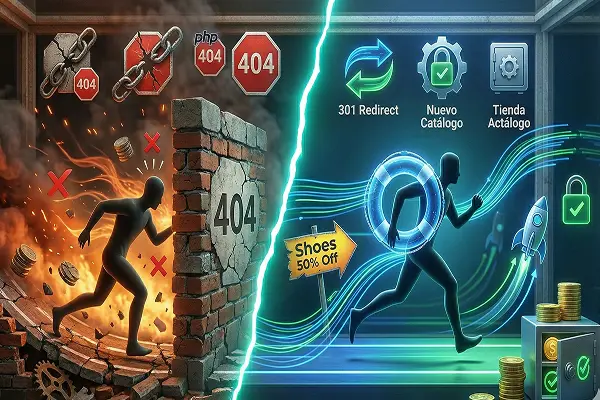
Imagine walking through an elegant shopping mall. You see a large, bright sign that says “Shoes 50% Off.” Excitedly, you follow the arrow, turn down the aisle, and suddenly find yourself face-to-face with a blank brick wall. No store, no shoes, no way out.
You feel frustrated, deceived, and you’ll most likely turn around and shop somewhere else.
In the digital world, that brick wall has a well-known technical name: Error 404 (Page Not Found). And those signs that deceive your users are the dreaded Broken Links.
At DapSite, we know that business owners constantly change and update their content. But if not done carefully, every product you delete or page you rename becomes a trap for your visitors. Here we explain why broken links are poison for your sales and your search engine ranking.
How Are “Dead Ends” Born?
Your website is like a city connected by roads (links). 404 errors don’t appear by magic; they are usually the result of your business’s normal evolution:
-
You deleted an old product: A shoe model sold out, and you simply deleted the page.
-
You renamed a service: You updated the title of an article, and your web automatically changed the web address (URL).
-
Dead external links: You recommended another company’s tool on your blog, but that company closed, and its website no longer exists.
The problem is that Google, Facebook, or Pinterest had already saved (indexed) the old address. When someone clicks that old link from Google, they dive straight into an abyss.
The 3 Collateral Damages of a 404 Error
Having broken links isn’t just an aesthetic detail; it’s a crack through which your resources leak:
1. The Instantly Frustrated Sale
The most obvious damage is losing the customer. The user had a clear intention to buy or read something you promised. Encountering a “404 Error” screen stops their momentum dead in its tracks. Instead of searching the rest of your website, 90% of users press the “Back” button on their browser to go to your competitor.
2. Severe Punishment from Google’s Algorithm
Google’s “bots” crawl your website using links as highways. If the Google bot constantly crashes into “brick walls” (404 errors), it assumes your website is poorly maintained, neglected, or abandoned. To protect its users from a bad experience, Google will push your page down in search results, ruining your SEO.
3. The “Abandoned Building” Image
A broken link communicates a profound lack of professionalism. It is the digital equivalent of having broken windows or burnt-out lights in your physical store’s display window. It immediately diminishes the trust the user feels toward your brand and services.
301 Redirects: DapSite’s Traffic Control
You can’t spend your days clicking every single one of the hundreds of links on your website to see if they still work. Your time should be focused on selling.
That is why, within DapSite Support Plans, we install automatic “radars” and apply redirection protocols:
| Situation | The Amateur Method | The DapSite Standard (301 Redirect) |
| Monitoring | You find out about the error when an angry customer emails you (if they even do). | Our system silently and automatically scans your site looking for the slightest broken link. |
| Deleting a product | You delete the page. Anyone trying to enter will see the hated 404 Error and leave. | We create a smart detour. If someone looks for the old product, we automatically send them to the new catalog. |
| SEO Health | Google penalizes you for having “blocked roads.” | We tell Google: “The content moved here.” You keep your ranking and traffic intact. |
Conclusion: Never Leave Your Customer Adrift
On the internet, fluidity is the key to conversion. Every click a customer makes should take them exactly where they expect to go, bringing them one step closer to a purchase.
How many broken links are sabotaging your sales right now without you knowing?
Don’t let your customers crash into a wall. With a DapSite Support Plan, we audit your traffic, repair broken roads, and build invisible bridges (301 Redirects) so users and Google always reach their destination.