

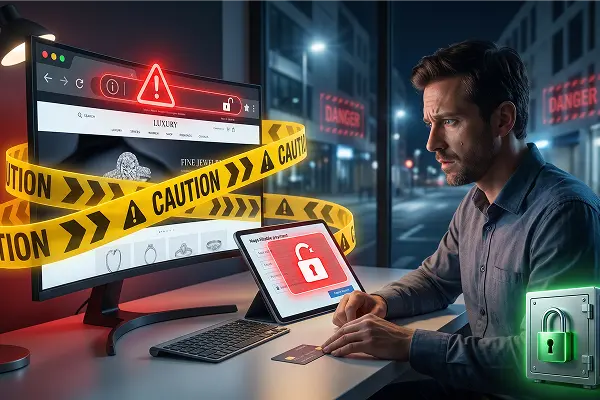
Imagine walking down the street looking for a place to eat. You see a restaurant with an incredible menu in the window, but draped across the front door is yellow police tape that reads: “DANGER: NOT SECURE LOCATION”.
Would you go in to eat? Would you hand your credit card to the waiter? Absolutely not. You would turn around instantly.
On the internet, that yellow police tape exists—it’s placed there by Google Chrome, and it appears right next to your website’s name. It is the dreaded “Not Secure” label.
At DapSite, we constantly receive clients whose websites were built by “amateurs” who forgot to configure the security padlock. Here we explain what this padlock is, why it is mandatory, and how its absence is scaring your customers away.
What is the SSL Certificate (The Green Padlock)?
When a customer enters their data on your website (their name, email, or credit card), that information travels across the internet to your server.
-
Without SSL (HTTP): The information travels in plain text, like sending it written on a postcard. Any hacker on the same WiFi network can read it.
-
With SSL (HTTPS): The information travels inside an encrypted vault. Only your server has the key to open it.
The SSL certificate is what activates that encryption and places the famous little padlock next to your web address.
The 3 Punishments of Having a “Not Secure” Website
Ignoring SSL security is no longer a “technical detail”; it is a massive commercial failure:
1. The Massive Client Leak (User Panic)
Modern browsers (Chrome, Safari, Edge) are designed to actively scare users if you don’t have SSL. When a customer tries to fill out your contact form, the browser throws a red alert warning that “attackers might be trying to steal your information.” Trust is broken in a millisecond, and the user abandons the page.
2. The Google Boycott (SEO Drop)
Google has officially declared that security is a ranking factor. Between two websites offering the same service, Google will always send the customer to the one with “HTTPS”. If your site is not secure, the search engine will bury you on page 10 of the results.
3. Payment Gateway Blockades
Stripe, PayPal, and modern banks demand secure connections. If your online store doesn’t have an active, well-configured SSL, the platforms will block your transactions. You literally won’t be able to get paid.
Permanent Security: DapSite’s Shielding
An SSL certificate isn’t bought once and lasts forever; it must be renewed periodically. Many websites suddenly go down because the owner forgot to renew the certificate the following year.
With DapSite Support Plans, we remove human error from the equation:
| Situation | Without Maintenance | The DapSite Standard |
| Installation | They charge for expensive certificates or configure them halfway, leaving “mixed” links. | We install and force bank-grade SSL certificates on 100% of your traffic. |
| Renewal | The certificate expires, the site shows a red error screen, and you panic. | Automated Renewal. Our system renews certificates weeks before they expire. You will never see an error screen. |
| Auditing | You upload an old image without “https” and break your site’s green padlock. | Constant scanning to prevent “Mixed Content.” We guarantee the padlock stays locked. |
Conclusion: Trust is the Currency of the Digital World
Before a customer decides to buy your product, they must first trust your platform. The “Not Secure” sign is the equivalent of locking your business from the outside.
Does your website show an “i” symbol or the phrase “Not Secure” in the browser?
You are losing sales right now. With a DapSite Support Plan, we implement strict SSL protocols so your customers can browse, leave their data, and buy with absolute peace of mind.