

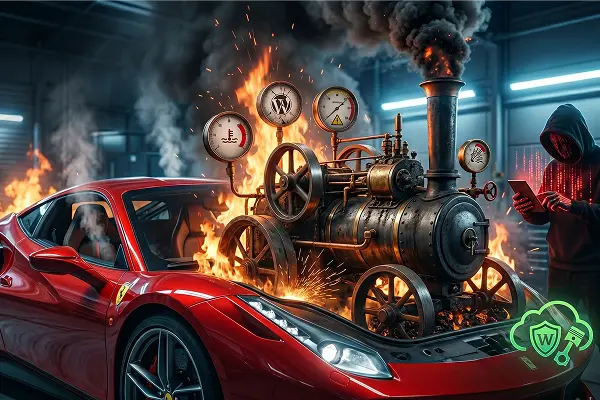
Imagine buying the latest model of a sports car. It has an aerodynamic chassis, flawless paint, and racing tires. But when you pop the hood, you discover the dealership installed an antique coal-powered steam engine. No matter how good it looks on the outside, that car will never win a race and will probably explode halfway down the road.
On your website, the design is the paint, but PHP is the engine.
At DapSite, we are constantly surprised by how many businesses invest thousands of dollars in web redesigns but leave their site running on PHP versions that stopped receiving support years ago. Here we explain what this “invisible engine” is and why keeping it updated is vital for surviving on the internet.
The 3 Dangers of Driving with an “Outdated Engine”
Ignoring the “PHP Update Required” warnings in your website dashboard exposes you to three critical threats:
1. The Open-Door Vulnerability (Hacks)
Old versions of PHP (like 7.4 or lower) no longer receive official security patches. This means that if cybercriminals discover a hole in that code, no one is going to patch it. Running outdated PHP is the equivalent of leaving the key to your safe hanging on the front door.
2. Unbearable Slowness
Each new version of PHP is designed to process tasks up to 30% faster than the previous one. If your competitor uses PHP 8.2 and you are still on PHP 7.4, their site will load fractions of a second faster. In e-commerce, that fraction of a second is the difference between a closed sale and an abandoned cart.
3. The Dreaded “Critical Error” (Incompatibility)
Live Engine Update: The DapSite Method
Updating PHP is not just pressing a button on your server; it’s a delicate process. If your theme or an old tool doesn’t support the new engine, the site will instantly collapse.
In our DapSite Support Plans, we change your business’s engine mid-flight and without turbulence:
| The Process | The Amateur Method | The DapSite Standard (Staging & PHP) |
| Testing | They update PHP on the live server and cross their fingers. | We clone your site and swap the engine in our private Staging environment. |
| Auditing | If the site crashes, they spend hours guessing which tool caused it. | We use debugging tools to pinpoint exactly which lines of code clash with the new PHP. |
| Transition | The site is down while they try to fix it. | We replace obsolete tools, ensure compatibility, and only push the new “engine” live when it roars perfectly. |
Conclusion: Don’t Let Old Tech Slow You Down
A modern design is useless if the brain operating it is obsolete. Keeping your PHP updated is a technical responsibility that guarantees military-grade speed and security.
Is there a red warning in your website dashboard asking you to update PHP?
Don’t ignore it, but don’t touch it without a backup plan either. With a DapSite Support Plan, we ensure your business’s engine is always the most powerful and secure version on the market, with zero risk of crashing.